with Elizabeth Johnson
& Luc Vanier
Baltimore, MD June 12-13, 2026
Pre-conference lesson times available with Elizabeth and Luc from 3 to 5:30pm
Friday evening: 6-6:30pm check-in and welcome / 6:30-9pm workshop
Saturday: 10-1pm and 2:30-6pm
Directions: University of Maryland Baltimore County, Performing Arts and Humanities Building (PAHB), Dance Cube studio. The Performing Arts and Humanities Building (PAHB) is located at 1000 Hilltop Circle, Baltimore, MD 21250 (the main UMBC campus address). It is situated on the north side of campus, easily accessible from adjacent visitor and event parking lots.
Early bird June 1st: $125.00 / After June 1st $150.00 [see Venmo payment link below or send money to admin@integralmovementresearch.com] Participants Lesson price: $80/40 minutes.
Parking: Free after 4 and on weekends in lot 8 and 9. For lessons before 4pm: Visitor parking is available in Lot 9 (behind PAHB). Parking costs $2.00 per hour and can be paid using credit cards at designated pay stations.
Contact email: vanier@integralmovementresearch.com

How do movement, posture, and coordination emerge and adapt within the body?
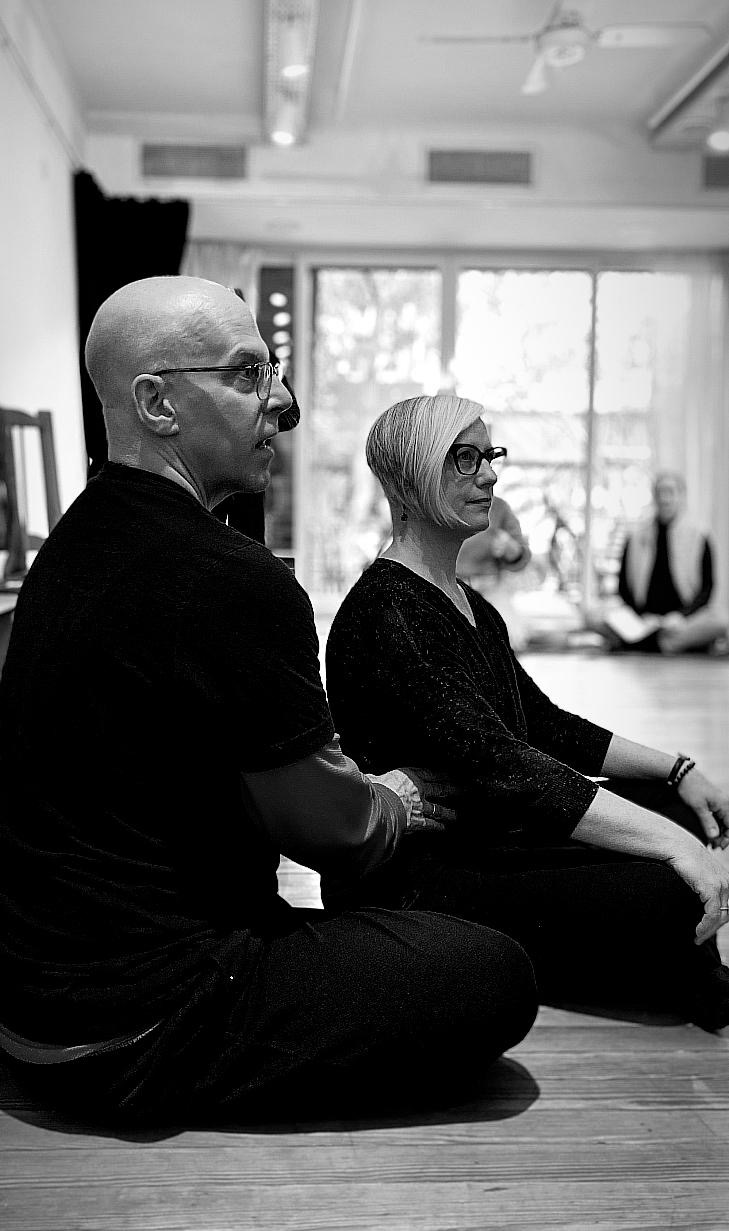
In this 1½-day workshop in Baltimore, Luc Vanier and Elizabeth Johnson introduce the Framework for Integration (F4I℠) alongside the Dart Procedures through movement exploration, observation, discussion, and hands-on work. Participants will investigate patterns of support, spirals, adaptability, and coordination as they appear in both everyday activity and professional practice.
Designed for Alexander Technique teachers and trainees, body-oriented therapists, and anyone working closely with human movement, the workshop offers a practical and experiential approach to understanding how the body organizes itself in action.
The Framework for Integration (F4I℠) presents a clear and accessible way of perceiving movement relationships within the body. Through a small set of guiding principles, participants begin to recognize patterns of support, effort, protection, and coordination that influence how we move, breathe, balance, and engage with our environment. In doing so, the work sheds light on some of the common assumptions and misunderstandings many of us — and often our clients — carry about posture, movement, and functioning.
Rooted in developmental movement, somatic practice, and the psychophysical principles of the Alexander Technique, the workshop shifts attention away from correcting form and toward perceiving relationships: primary and secondary support, engagement and release, spirals and counter-spirals, adaptability and responsiveness.
Rather than pursuing fixed ideas of alignment or perfection, participants explore coordination as a living, responsive process — one shaped by awareness, curiosity, and context.
Throughout the workshop, participants move fluidly between table work, embodied exploration, observation, reflection, and practical applications to everyday activities such as sitting, walking, reaching, and speaking.